 Log in

 Workplace health and safety policies built around a male default leave millions of women exposed to risks that better regulation could prevent.

|
[he/they] Queer, trans, disabled, disgruntled. Former librarian, future dust.
|
Workplace health and safety policies built around a male default leave millions of women exposed to risks that better regulation could prevent.


The latest effort to make healthy women believe they are ill is a new movie on perimenopause, “The M Factor 2: Before the Pause,” which debuted March 19 on PBS. The film is a sequel to “The M Factor,” a movie that not only medicalized menopause, but lost accreditation as an education activity for physicians after our project coordinated a complaint that was co-signed by international women’s health experts.
“Before the Pause” expands medicalization to midlife, telling women in their 30s that their hormones are starting to run amok and will ruin their cognitive, physical, and mental health. The film begins with a woman’s frightening retelling of the day that she was asked for her name and could not recall what it was. The film encourages women to “shred the silence” on the epidemic of menopause and offers merchandise to help supporters spread the word.


Yeah, they really need to put author affiliations at the top of articles
Epiphyte City

Counterpoint: health insurance/capitalism wants women to suffer, always. And "author affiliations" should be shown at the beginning, not the end.
This piece is just as much bullshit as the puberty video they showed us in 4th grade that said we'd feel fine during our periods if we'd just keep doing normal stuff like...playing basketball.
I had not then, or ever since, wanted to play basketball, even on the days when my insides weren't turning outside.
This piece is just as much bullshit as the puberty video they showed us in 4th grade that said we'd feel fine during our periods if we'd just keep doing normal stuff like...playing basketball.
I had not then, or ever since, wanted to play basketball, even on the days when my insides weren't turning outside.
FRA again


The glial cells’ activity reliably tracks with freezing, hesitancy and other behaviors reminiscent of anxiety.

It's already known that astrocyte activity in ASD can influence behavior. Bet they can also be (at least partly) responsible for the frequently-comorbid anxiety/depression.
Same in MS, where astrocytes "lose homeostatic functions and gain neuroinflammatory phenotypes" -- and PwMS have some of the highest depression rates of any chronic illness (even when compared to life-threatening conditions like brain tumors).
Same in MS, where astrocytes "lose homeostatic functions and gain neuroinflammatory phenotypes" -- and PwMS have some of the highest depression rates of any chronic illness (even when compared to life-threatening conditions like brain tumors).
FRA again


If you’ve heard about “droning,” you might think it’s something out of a sci-fi movie. But recently, a story in the U.S. Sun highlighted a growing trend that is hitting much closer to home.
Insurers are now using drones to capture video of your yard, your roof, and the overall exterior of your property. They then feed that footage through Artificial Intelligence (AI) to look for issues. The result? Some homeowners are receiving notices that say, “Fix your roof right now, or you’re canceled.”
My Personal Drone Headache
I recently had a very frustrating experience with my own homeowners insurer. They flew a drone over my house and used AI to grade my roof. Their conclusion? They claimed my roof dated back to 2004, making it 22 years old.
There was just one problem: I replaced my roof in 2017.
You cannot imagine the hassle it was to get this corrected. Even after I provided the proper documentation, they asked for it a second time. It became very clear to me that these companies now trust their drones and AI more than they trust their own customers.
Why the Data Matters
In politics, there is an old saying: A lie unanswered becomes the truth in 24 hours. The same applies to your insurance record. If your insurer “drones” your home and comes up with a report that is factually incorrect, you cannot simply ignore it.
If you let an incorrect report stand, you risk:
- Policy cancellation: Being dropped by your insurer with very little notice.
- Sky-high premiums: Paying more because the AI thinks your home is a higher risk than it actually is.
- Claims denials: If a storm hits and the insurer believes my roof is 22 years old instead of seven, they will depreciate the value so heavily that they’ll pay me nothing. They’ll essentially tell me to “go have fun” paying for a new roof out of pocket.
What You Should Do
If you receive a notice from your insurer based on a drone or satellite inspection:
- Don’t take it sitting down: If the information is wrong, challenge it immediately.
- Provide proof: Keep your receipts, permits, and contracts for any major home repairs (especially roofs).
- Be persistent: As I found out, you may have to send your documentation multiple times before they acknowledge the error.
Your roof’s “official” age is a vital piece of data. Make sure your insurance company has the right numbers, or it could cost you thousands of dollars down the road.
The post Is Your Insurer Secretly Using Drones To Drop You? appeared first on Clark Howard.
With homeowner headaches becoming a champagne problem, this won't worry everyone...but it should.
FRA again

Last December we reported on indications that the Transportation Security Administration (TSA) had begun passing on information from airline reservations to Immigration and Customs and Enforcement (ICE) to enable targeting of domestic airline passengers for seizure and deportation. Ten days later, our report was confirmed by the New York Times. In January, it was reported […]
FRA again


Recently I had to take my dog in for surgery. Over nearly 20 years of owning multiple dogs, this isn't new. But this is the first time design actually played a helpful role for my pet's post-op care.
At every other veterinary practice I've been to—over a half-dozen, from Manhattan to the rural countryside—they hand you med vials with the dosage instructions printed on them. The font on the labels is tiny (requiring reading glasses, for me) and it's impossible to read a full sentence without rotating the vial.
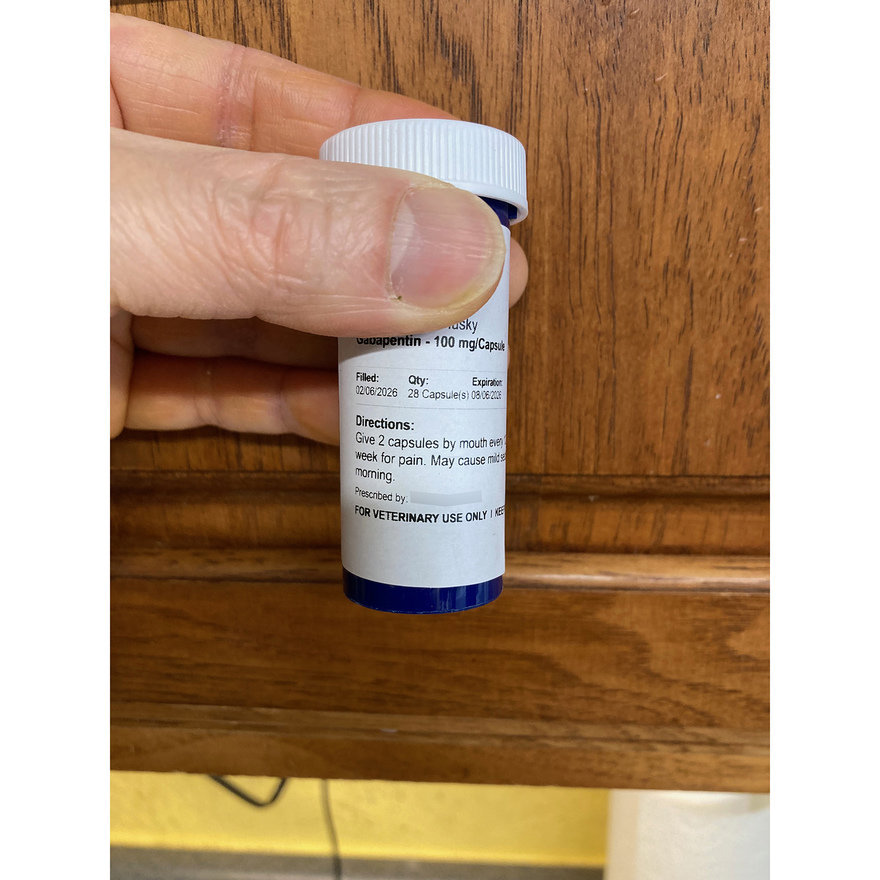
This time, however, this new vet handed me this simple chart:
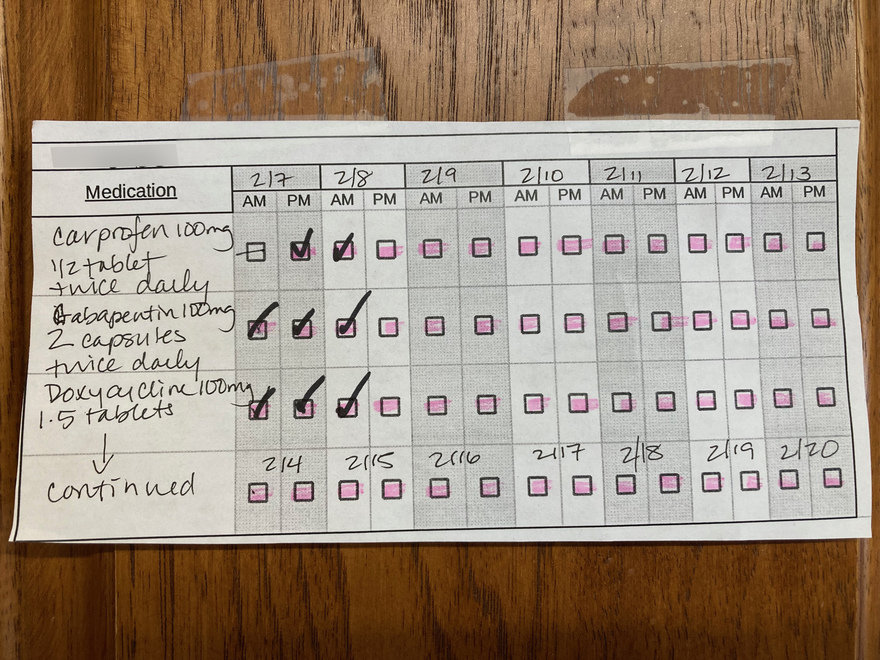
I was really impressed by the low-tech efficacy of the design. The days are delineated by tonal differences, and a pink highlighter was used on all but one of the boxes, to remind me that one of the drugs was not to be administered on the morning of 2/7 (due to lingering medication from the surgery, I was verbally told). Two of the drugs are meant to be administered for 7 days in a row, and the third for 14 days in a row; the vet tech was easily able to modify the chart to indicate this.
All of this information is on the three barely-legible labels on the vials. But by consolidating it into one chart, the vet practice made the information much easier to grasp and track.
I do wonder why, having been to so many vets, this is the first time I'd seen such a chart. It should be standard practice.
I always make my own similar chart (for human meds) -- it's so good to see someone in a *position of authority* doing the same for others under their care.
Doctors/surgeons will send you home with sheaves of printouts but never this one simple thing that could actually increase med adherence, prevent med mistakes, and improve communication among carers, patients, and providers.
Doctors/surgeons will send you home with sheaves of printouts but never this one simple thing that could actually increase med adherence, prevent med mistakes, and improve communication among carers, patients, and providers.
FRA again

New York, NY
1 public comment
Next Page of Stories